Honor levels: conditions, cost and payout
Honor levels are the last hero track, and it opens once a hero has every star. There are 600 of them, they work the same way for every hero, and they pay out in hit point…
☰ On this page 15 ▾
🗓 Updated: 2026-10-12
Data verified against the game client (v1.0.87, source: wiki-last-asylum.com).
Honor levels are the last hero track, and it opens once a hero has every star. There are 600 of them, they work the same way for every hero, and they pay out in hit points alone. The price is charged in the same personal shards that went into stars, so honor continues an existing expense rather than starting a new one.
Three conditions to start
The track does not appear by itself, and the honor screen stays closed until three conditions are met.
- The hero is at maximum stars, all 50.
- The statue of their faction is built and raised to at least level twenty.
- The hero’s personal shards are in stock, the same ones that went into stars.
The honor screen is entered through the statue itself: warriors through the Warrior Statue, warlocks and rangers through theirs.
What it costs
The price of a level climbs as the track goes on, from ten shards for the early levels to forty for the last ones.
| Stretch | Shards per level |
|---|---|
| Early levels | 10 |
| Middle | 20 and 30 |
| Late | 40 |
All 600 levels together cost 15,030 shards of a single hero, noticeably more than any individual star asks for.
What it gives
Honor grants hero HP and nothing else. The bonus is labeled as coming from the Hall of Honor and stacks with every other source, and it scales in proportion to the level: 160 HP at level 1, 64,000 at level 300 and 240,000 at level 600.
Later levels cost more and give proportionally more, because the rate holds at 16 HP per shard the whole way. Saving shards for a cheap stretch is pointless, as no such stretch exists.
Two more values sit beside each of those, twice and four times as large: 320 and 640 at level 1, 480,000 and 960,000 at level 600. They are probably the numbers for rarer heroes, but the guess could not be confirmed, since the game never shows which of them applies.
What it means in practice
There is no choice between stars and honor, because honor opens only after stars and eats the same shards. The real choice comes earlier, at the statue. Until the faction statue reaches level twenty, shards spent on a finished hero sit idle.
Hall of Honor: Practice Notes (Community)
The client reference above describes the star-track side of Honor. The community practice below covers how players actually route fragments through the Hall once heroes arrive there — entry, global health, faction checkpoints and shard economy.
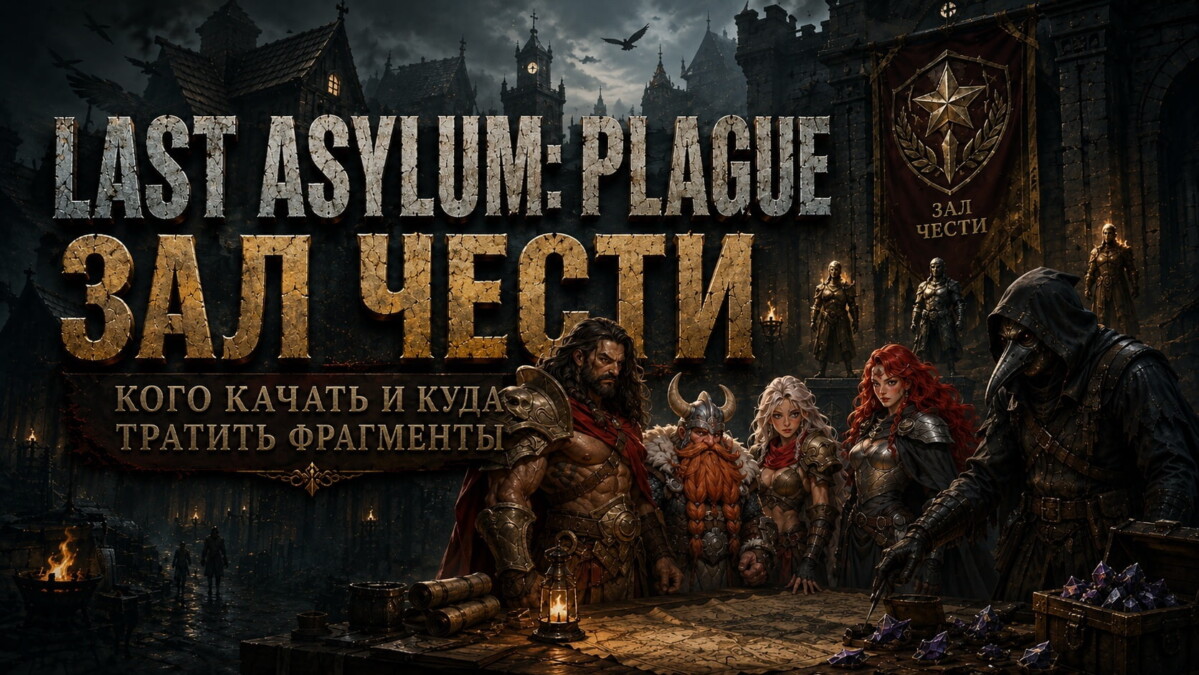
Entry: 10 stars, no stats for arriving alone
In this guide a hero becomes available in the Hall of Honor after 10 stars, with nothing extra to unlock. Arriving alone grants nothing — bonuses start only when you keep leveling the hero inside with personal shards or matching universal shards.
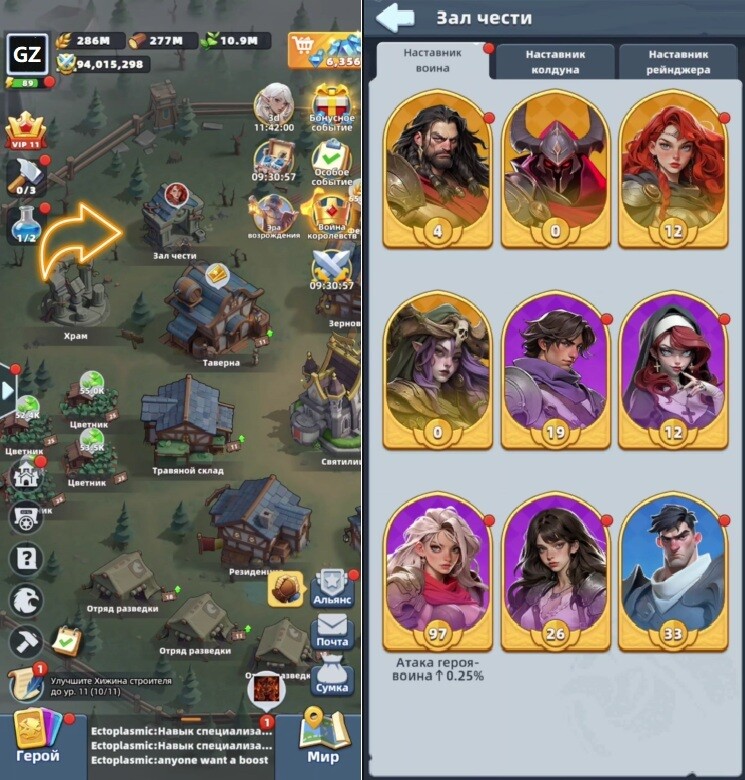
Do not convert universal shards into Hall levels just because a red dot lights up — especially gold ones. Pick the hero and the checkpoint first, then spend.
One hero levels, every hero gains health
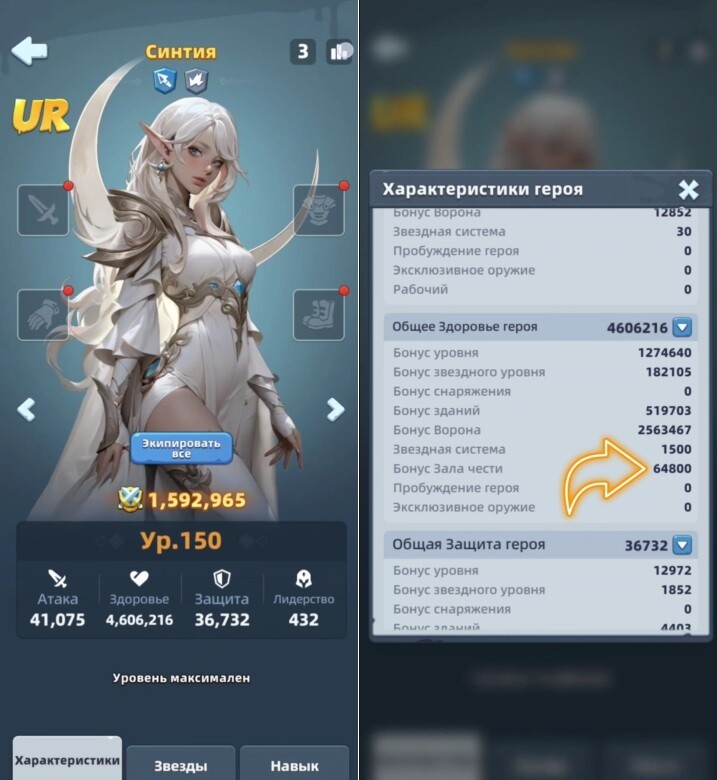
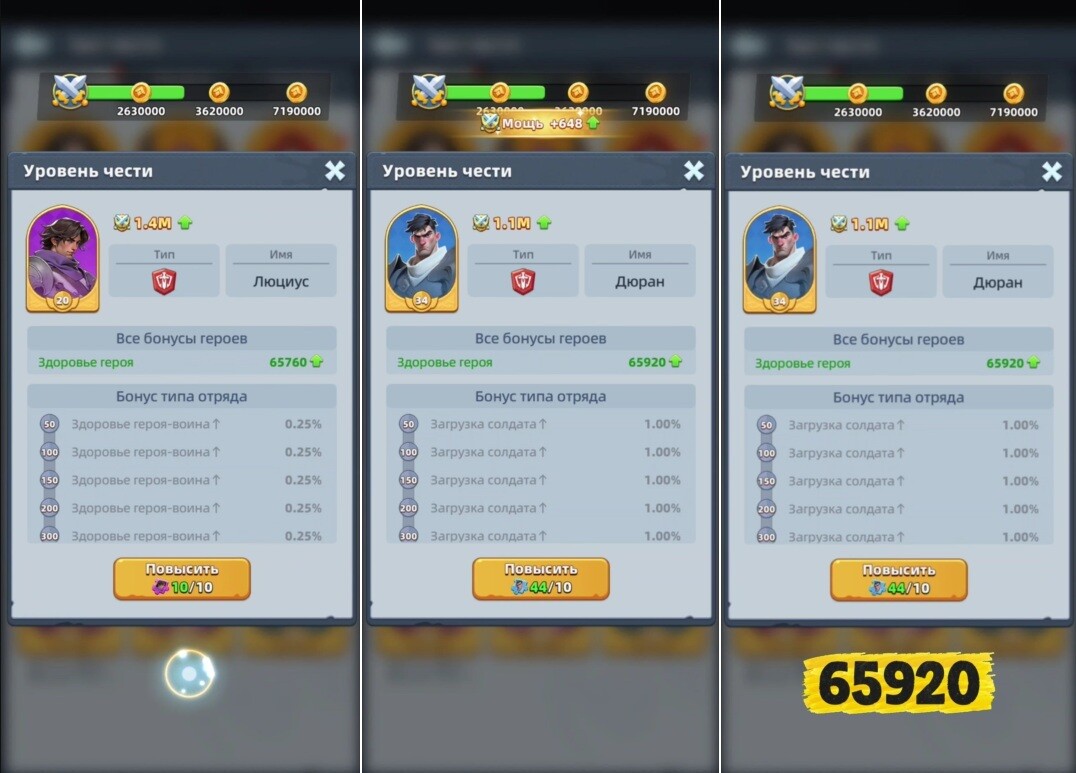
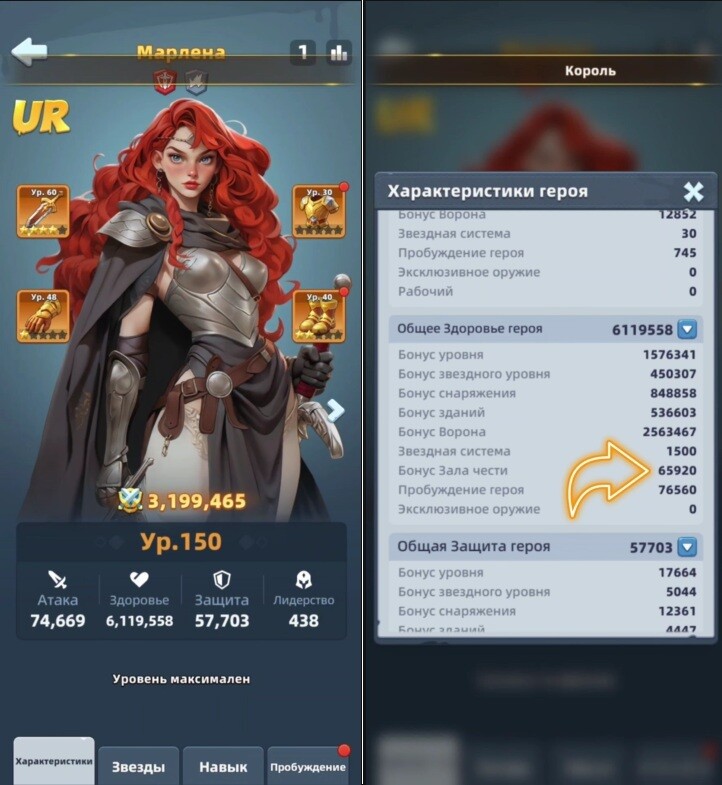
The base mechanic: each Hall level on any hero raises the account-wide health bonus for the whole roster, regardless of faction, rarity (gold, purple, blue) or whether the hero still fights.
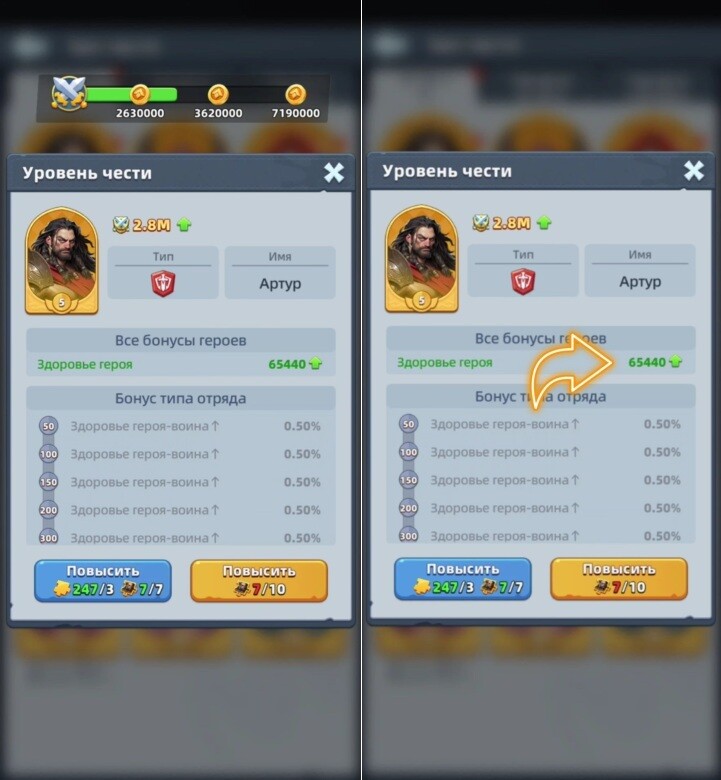
Level one hero from one faction and Rangers and Warlocks gain too; level another faction and the total climbs again. Single levels look trivial, but dozens and hundreds add up on an old account. Rarity scales the payout (gold gives more per level than purple, purple more than blue) — but price matters more than payout, so judge cost per stat, not stat alone.
Faction checkpoints: only the hero’s faction gains
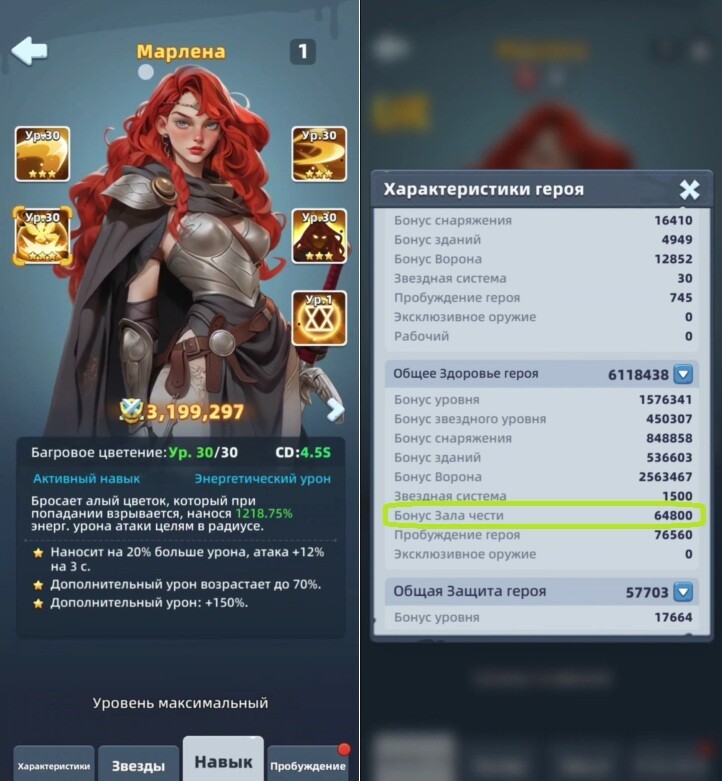
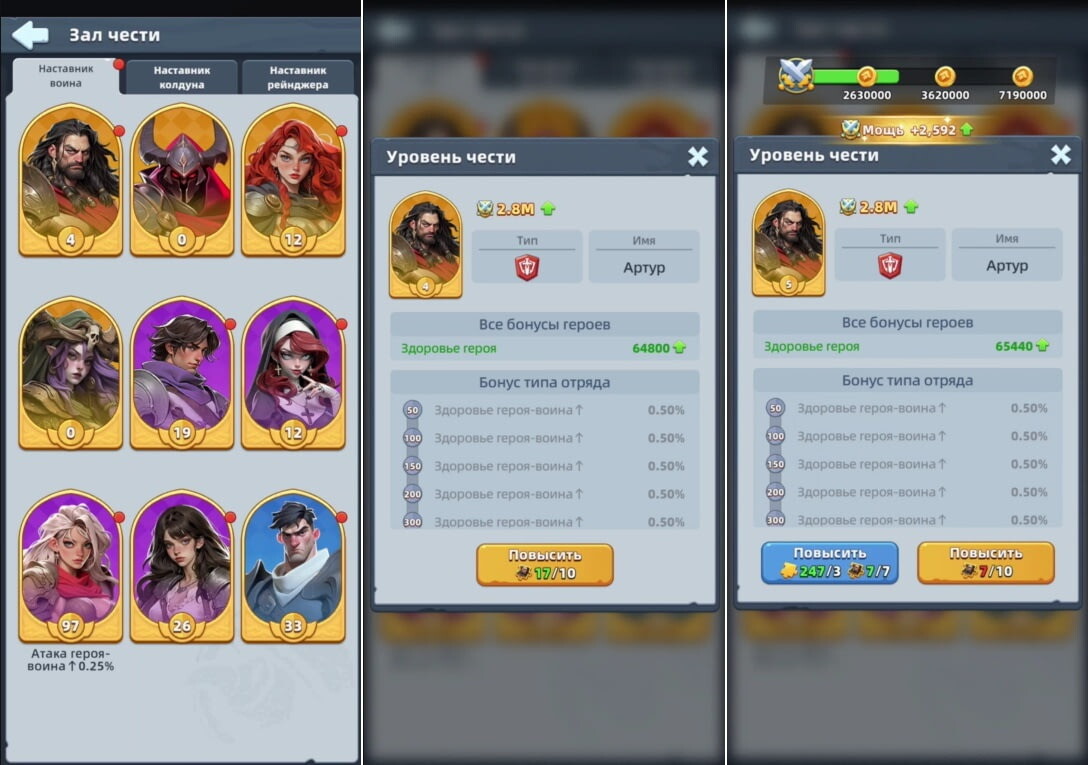
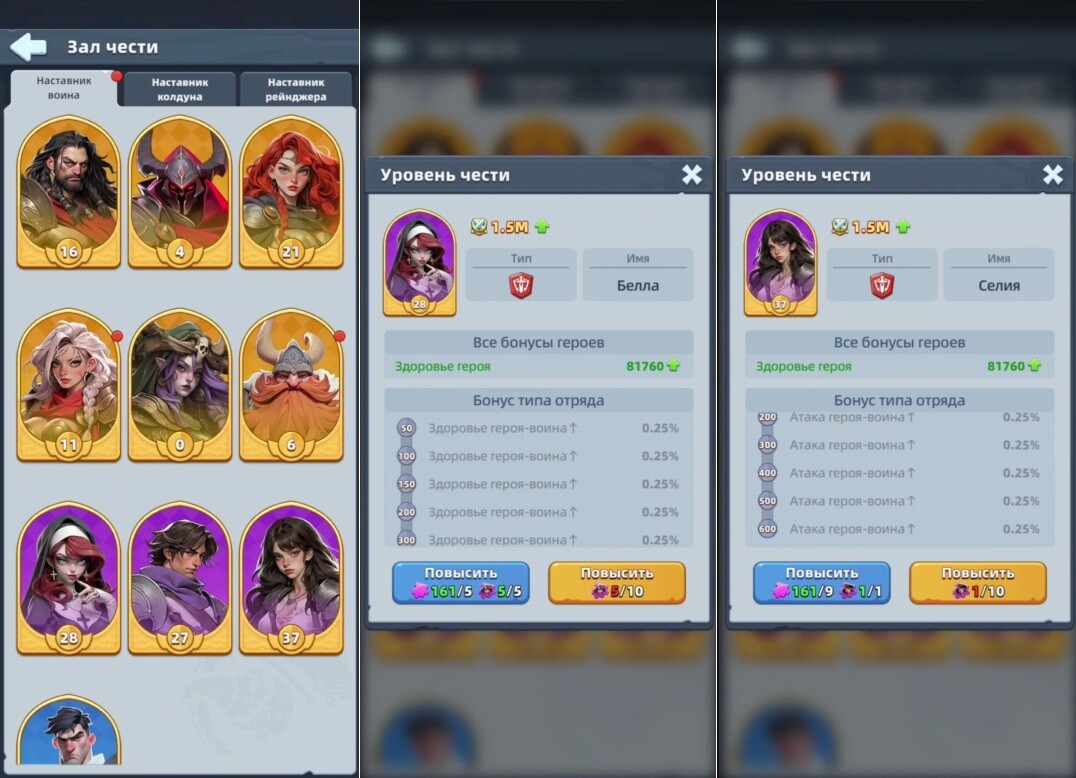
Gold and purple heroes unlock extra bonuses at fixed Hall levels. Unlike global health, these apply only to the leveled hero’s faction: a Warrior opening attack buffs Warriors, not Rangers or Warlocks. The stat itself varies per hero (attack somewhere, health or defense elsewhere), so pick by faction first and by bonus second.
Checkpoint levels: 50 → 100 → 150 → 200 → 300
The first extra bonus opens at Hall level 50, then every 50 up to 200 (50 → 100 → 150 → 200), then the step widens to 100 with the next at 300. Example from the guide: Claire raises Warrior heroes’ attack by 0.25% at her checkpoints, Arthur raises Warrior heroes’ health by 0.50% — for a Warrior damage march Claire’s attack is the interesting one, for survival Arthur’s health.
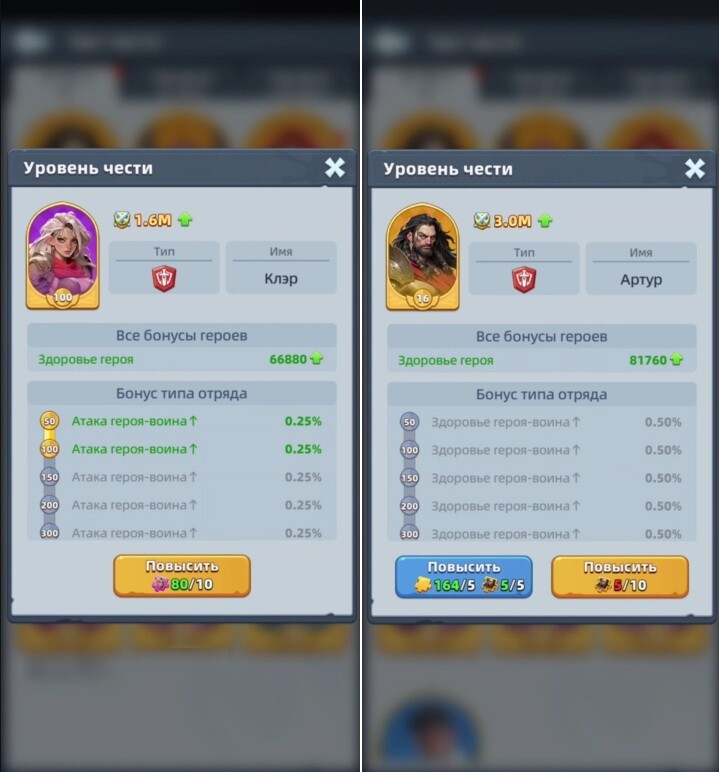
Up to 200 the four bonuses sit close together, which makes that stretch the efficient one; past 200 the next meaningful bonus waits until 300 while costs keep rising.
Route like this, not “I like this hero”: main faction → needed stat → nearest checkpoint → shard cost — then press upgrade.
Blue heroes: load capacity and a cheap Hall entry
Blue heroes add global health like everyone else, plus soldier load capacity (resources carried per gathering run) as their extra. Not flashy, but steady farm value — and universal blue shards are far cheaper than gold or purple ones.
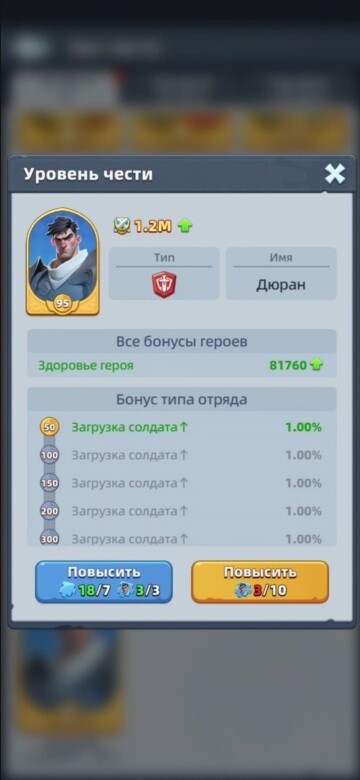
Pick whichever blue already has the most stars and personal shards and take it to 10 stars with universal blues; do not start a prettier portrait from zero just for looks.
Gold heroes: personal shards only
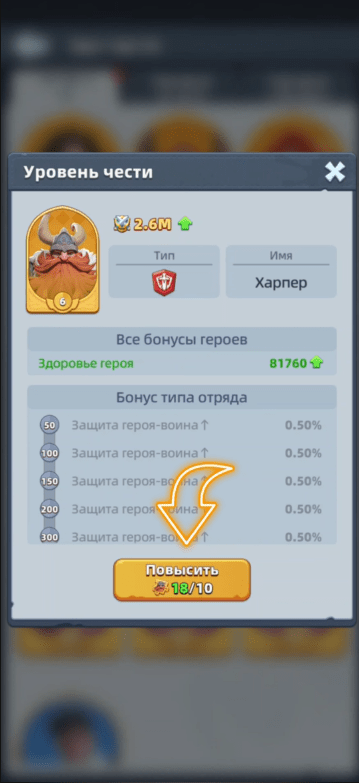
Develop gold Hall heroes with personal shards. Universal gold shards look spare until an update drops a new meta hero — and 50–100 spent universals cannot come back. On a developing account a new star on a strong hero usually beats several Hall levels, F2P especially.
Purple first picks: Claire, Ash, Stellar
Spend universal purple shards deliberately on three heroes to 10 stars first — Claire, Ash and Stellar — not for the Hall itself but as Demon King PvE supports, each buffing its faction’s damage: Claire helps Warriors (Call of the Brave), Ash boosts Rangers (Focus), Stellar works with Warlocks (Wishing Star). That buys a PvE helper now and its Hall track afterwards.
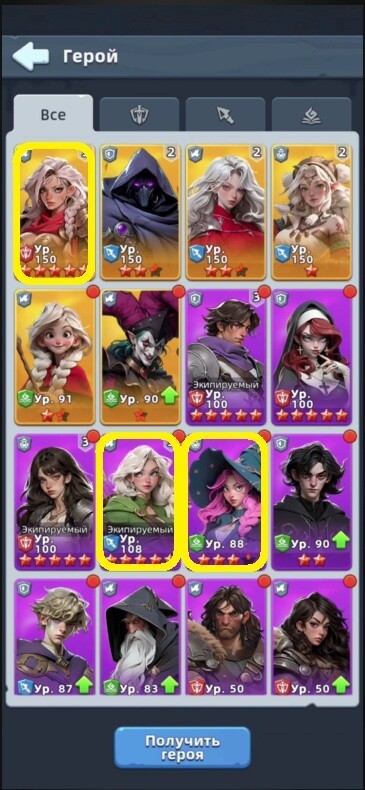
Other purples: if one actually plays (Arena, Triangle, PvE, main march), finish it to a working star count first — a working hero helps now, the Hall is a slow account bonus. Principle: needed characters → free universals into the Hall. Do not spray ten directions at once.
Inside the Hall: one hero to its checkpoint
With core and PvE picks done, open same-faction Hall heroes and take the most useful near-term bonus — usually attack for an attacking squad. Drive one hero to its checkpoint and collect the full faction bonus before moving on: five heroes at +10–20 levels each spends the shards with possibly zero checkpoints to show for it.
Up to 200, step hero by hero through close checkpoints (one may give attack, another health or defense — the route across two heroes often beats maxing one). At 200, pause and compare: continuing one hero to 300 versus starting a second same-faction hero.
Blue method and second-squad rule
Blues: one most-starred hero, universal blues into it, through 10 stars and on into the Hall — global health plus load bonuses faster than four slow crawls.
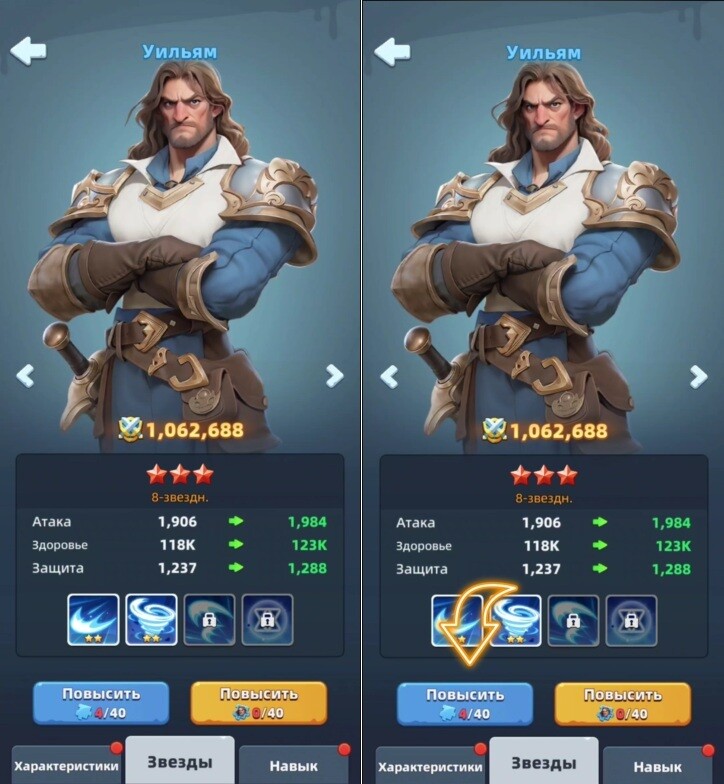
Do not starve the second squad for the Hall: main squad → needed second-squad heroes → key PvE → free resources into the Hall. A new star can open or boost a skill and change a second march; a few Hall levels rarely do. Personal shards of an already-10-star hero, of course, belong in the Hall.
Why the Hall compounds
Global health applies to every hero that ever arrives: today’s levels for five mains become the starting bonus of the second and third squads months later, and of each newly recruited hero. The “bit by bit” adds into a serious number with server age.
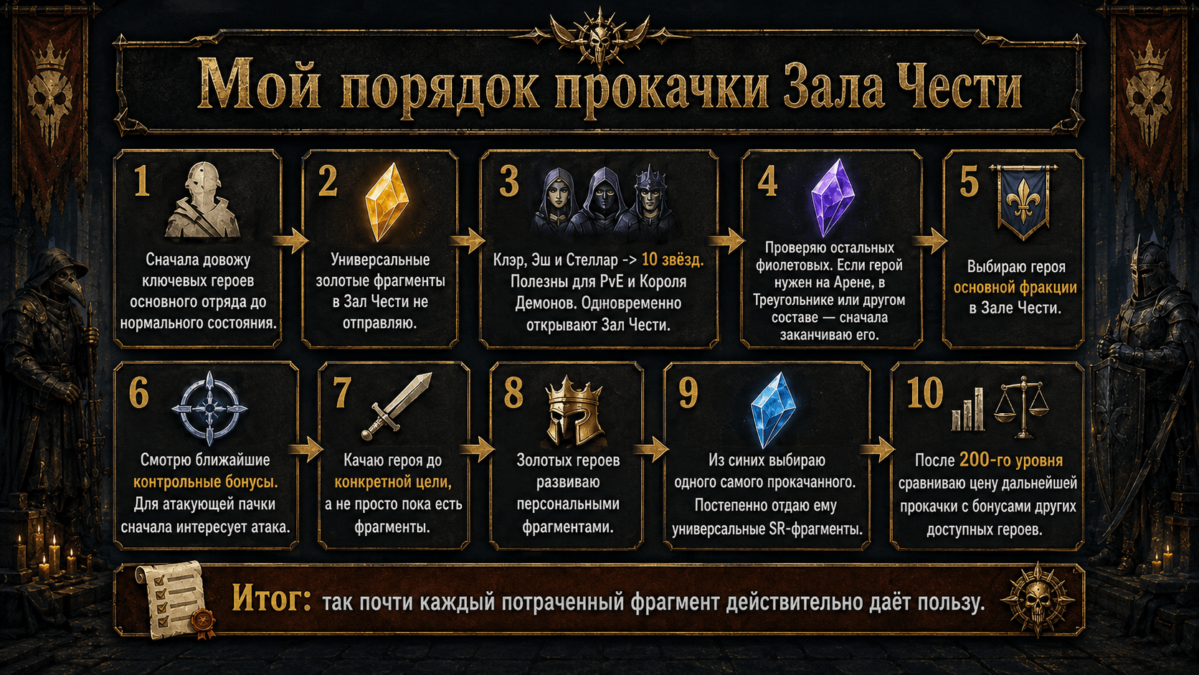
Rule of thumb: real account tasks first (main squad, key stars, needed PvE heroes); leftovers into the Hall; universal golds kept in reserve. Tie any top-up to a concrete checkpoint (50/100/200 on the right bonus), never to “somewhere in the Hall”.
Source: Зал Чести в Last Asylum: Plague - кого качать и куда тратить фрагменты by Гейм-Знаток on DTF.
📖 Read next
Did this guide help?